India, in Infographics: Digital Payments
The Average UPI Payment Fell From ₹4,400 To ₹1,217
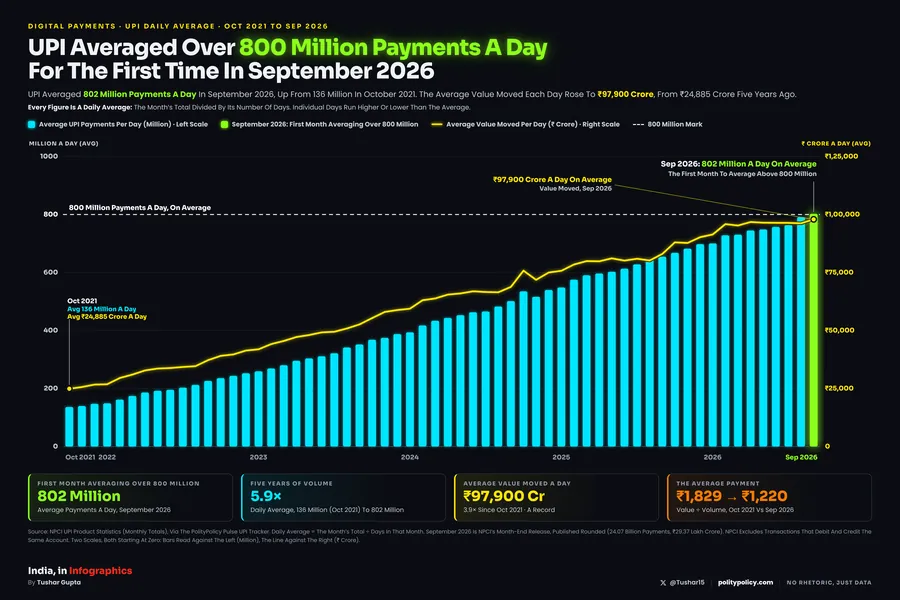
India’s Unified Payments Interface Now Handles Around 79 Crore Transactions A Day — But The Average Payment Has Steadily Shrunk, From About ₹4,400 In Early 2017 To ₹1,217 By August 2026, As It Spread Into Everyday Small Purchases. Three Views Below — Hover Any Month To See Its Volume, Value And Average Together.
Three Views Of The Same Monthly NPCI Data. Average = Value ÷ Volume (₹ Per Transaction, From Dec 2016). Volume And Value Are Per-Day Averages (Each Month’s Total ÷ Days In Month), April 2016 To August 2026. Source: NPCI Product Statistics, Via politypolicy.com/pulse/UPI.
Average Payment, Aug 2026
₹1,217
Down From A Peak Of ₹4,424 In February 2017.
The Peak, Feb 2017
₹4,424
When UPI Was Still Mostly Large Person-To-Person Transfers.
Of Its 2017 Size
About A Quarter
The Typical UPI Payment Is Now Roughly A Quarter Of Its Peak.
Transactions, Aug 2026
79 Cr / Day
Even As The Average Shrank, The Number Of Payments Exploded.
What The Numbers Say
A Falling Average Is The Sign Of UPI Going Mainstream. In Its Early Years UPI Was Used Mostly For Large Person-To-Person Transfers, So The Average Payment Sat Above ₹4,000. As It Spread To Everyday Spending — Kirana Stores, Autos, Vegetable Carts, QR Codes On Every Counter — The Typical Payment Fell To Around ₹1,217, Even As The Number Of Payments Rose To Roughly 79 Crore A Day. A Smaller Ticket Is Not Weakness: It Means Digital Payments Have Reached The Tens- And Hundreds-Of-Rupees Transactions That Were Once All Cash. The Average Has Broadly Steadied Near ₹1,200 In Recent Years, Suggesting UPI’s Everyday-Payments Mix Has Matured.
How This Was Built
The Numbers
Monthly UPI Totals — Volume (Transactions) And Value (₹) — Are NPCI Product Statistics, As Carried In PolityPolicy’s Pulse/UPI Tracker. Volume Is In Transactions; Value In Rupees.
Average Value Per Transaction
Each Month’s Total Value Divided By Its Total Number Of Transactions, In Rupees. The Series Begins In December 2016: UPI’s First Eight Months Were A Pilot With Negligible, Rounded Volumes (Under 3 Lakh Payments A Month), Which Make A Per-Transaction Average Meaningless. The Page Also Toggles To Transactions Per Day And Value Per Day.
Sources: NPCI UPI Product Statistics, Via PolityPolicy’s Pulse/UPI Tracker. Retrieved 15 September 2026.